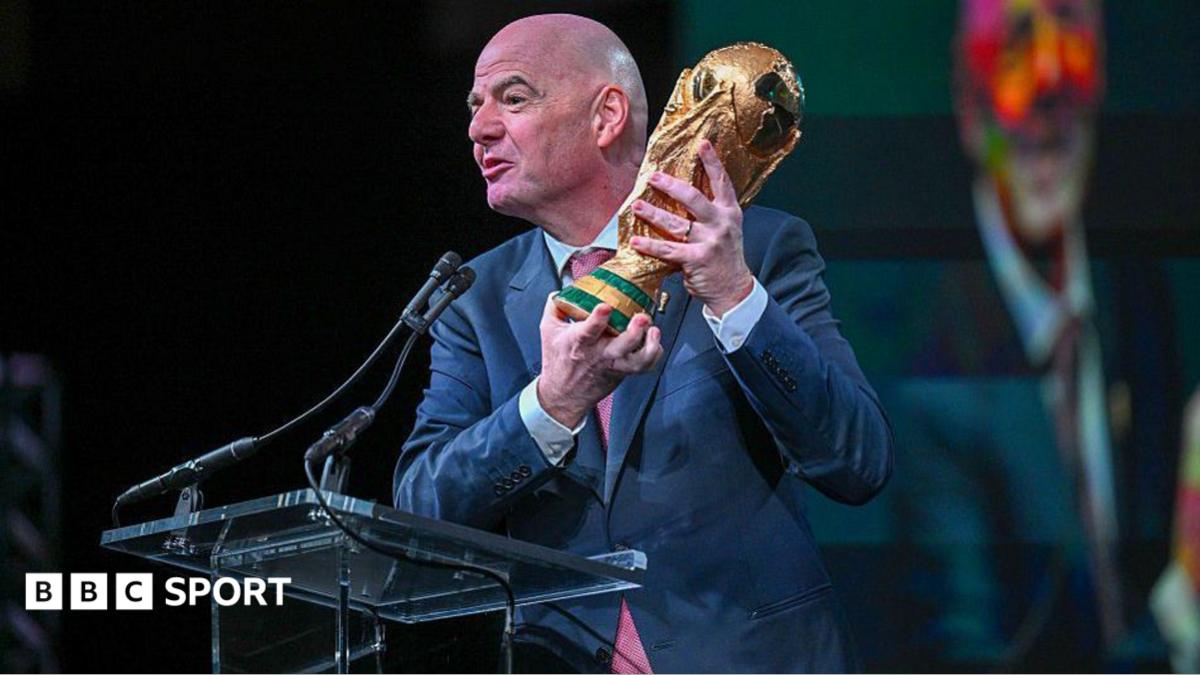
Infantino Pushes 64-Team World Cup Format: FIFA President's Expansion Plan Faces Opposition
Key Points
- Infantino cited fairness to smaller nations as reasoning for 64-team expansion, though qualifying already admits competitive smaller teams like Cape Verde and Jordan.
- South American confederation Conmebol requested the 64-team format in April 2025 to host additional matches for centenary 2030 World Cup games.
- UEFA president Aleksander Ceferin called the plan a "bad idea" for the tournament, while AFC president Sheikh Salman warned of potential "chaos."
The push toward 64-team expansion gained concrete momentum in April 2025 when South American confederation Conmebol formally requested the format as a one-off proposal. Conmebol president Alejandro Dominguez framed the expansion as ensuring "nobody on the planet is left out of the party." The request directly relates to the 2030 World Cup centenary celebration, which will mark 100 years since the first World Cup held in Uruguay. While Morocco, Portugal, and Spain will serve as primary hosts, opening matches are scheduled for Uruguay, Argentina, and Paraguay as centenary hosts—a structure that Conmebol believes requires additional tournament capacity.
Global Football Bodies Split on Expansion
Read Next
Tuchel's England Squad Explained: World Cup Lessons Applied
21 hours ago

Fitzroy River with 500 Crocodiles Approved for 2032 Brisbane Olympics Rowing
1 days ago
The 64-team proposal has generated minimal support beyond South America. UEFA president Aleksander Ceferin dismissed the idea as a "bad idea" affecting both the tournament itself and the qualifying process. Victor Montagliani, president of Concacaf (the governing body for North and Central America and the Caribbean), expressed concern that expansion would damage "the broader football ecosystem." Asian Football Confederation president Sheikh Salman bin Ibrahim Al Khalifa agreed, warning that further expansion could bring "chaos" to international football.
The split among continental confederations reflects broader concerns about tournament saturation and competitive integrity. Infantino's tenure has already introduced the Club World Cup expansion and increased ticket prices, alongside the controversial 27-minute, 22-second half-time break at the recent World Cup final designed as a "Super Bowl-style show."
Related coverage: Tuchel's England Squad Explained: World Cup Lessons Applied
The 64-team format represents a continuation of Infantino's expansion philosophy since his election to FIFA presidency on a manifesto that included increasing the World Cup's scope. Each expansion iteration—from the traditional 32-team format that persisted for decades to the recent 48-team format debut, and now toward 64 teams—generates mounting skepticism from governing bodies responsible for the sport's competitive balance.
Why This Matters
If you follow international football, a 64-team World Cup would fundamentally alter qualifying pathways and tournament scheduling for your national team. Smaller confederations like Concacaf and the AFC would see their relative influence diluted further, while European and South American nations would maintain advantages in a larger draw. For fans, the expansion means more matches to watch but potentially diluted competition quality—and your regional confederation's qualifying odds would shift significantly depending on how FIFA structures the new format.
Sources: Publicly available news sources.
Disclaimer: This article was produced with AI assistance based on publicly available news sources. While we strive for accuracy, NewsOracle makes no warranty as to the completeness or accuracy of the information. Errors and omissions may occur. Readers should independently verify all information before acting on it. NewsOracle does not intend to defame any individual or organisation and accepts no liability for any loss or damage arising from reliance on this content. Content is for informational purposes only and does not constitute legal, financial, medical, or professional advice. All rights reserved. Unauthorised reproduction prohibited.
Sports Desk
The NewsOracle Sports Desk covers breaking sports news from the NFL, NBA, Premier League, UFC, tennis, cricket and major global sporting events.
Latest coverage: FIFA World Cup