Zcash Launches Zakura Node Targeting 50,000 Transactions Per Second

Key Points
- Zakura version 1.0.0 launched July 19, 2026, as a pruned fork of Zebra designed to reduce node sync time to under two minutes, 680 times faster than current methods.
- The software targets 50,000 transactions per second, matching Visa and Mastercard throughput, requiring dramatic reductions in verification data and wallet performance bottlenecks.
- Sean Bowe and Dev Ojha lead development funded by private ZEC donations; Project Tachyon will use recursive proofs to cut consensus data requirements from 100 MB/s to 500 MB/s.
Solving the Throughput Puzzle
The core challenge Zakura addresses is mathematical. Processing 50,000 transactions per second while maintaining Zcash's privacy guarantees would require nodes to verify more than 500 megabytes of data every second under the network's existing cryptography, according to the developers. This occurs because every private transaction carries a cryptographic proof of validity, and these proofs are large. To put this in scale: 500 megabytes per second equals approximately one full DVD of data arriving continuously every ten seconds—a throughput no current Zcash software supports.
Read Next

Treasury Sanctions BitBank Exchange Behind Iran's Bitcoin Hormuz Tolls
21 hours ago
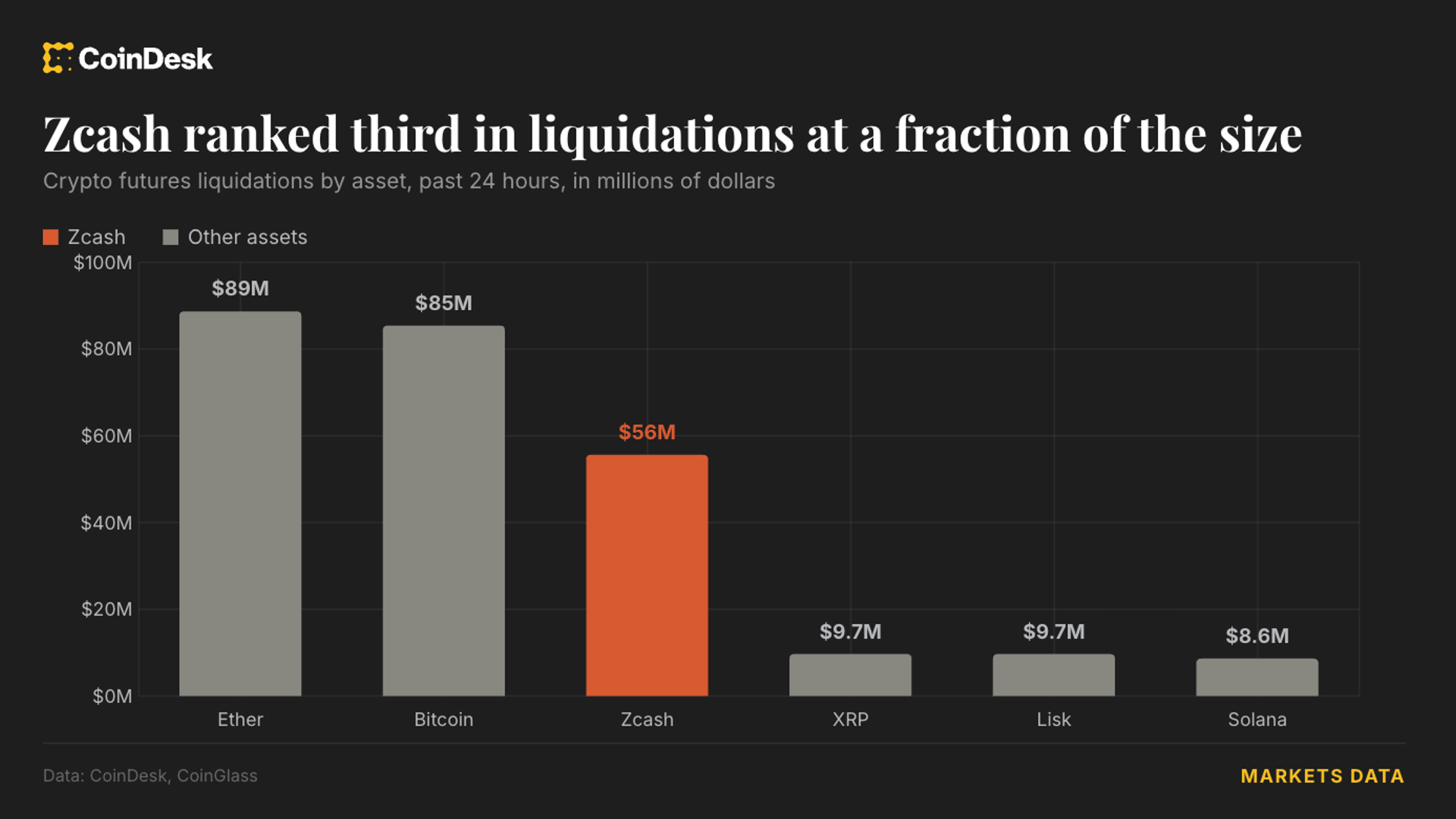
Zcash Jumps 17% as $345M in Crypto Liquidations Hit Traders
1 days ago
Zakura includes a compatibility mode that reproduces the interface of zcashd, the original Zcash client reaching end of life on July 18, 2026. This feature ensures wallets and exchange integrations built against the legacy client continue functioning without modification, providing a migration bridge for the ecosystem.
The software also supports the Ironwood upgrade (designated NU6.3), scheduled to activate on July 28, 2026. This upgrade introduces a turnstile mechanism to cap withdrawals from Zcash's Orchard shielded pool and contain any counterfeit ZEC potentially created through a long-standing soundness bug in the protocol.
Related coverage: Treasury Sanctions BitBank Exchange Behind Iran's Bitcoin Hormuz Tolls
Zakura represents only the first pillar of a broader scaling initiative. Sean Bowe's Project Tachyon tackles the consensus data bottleneck by developing recursive zero-knowledge proofs—cryptographic constructs where a single proof attests to the validity of thousands of others. Under this approach, nodes verify one proof instead of thousands, theoretically reducing the consensus data requirement from 100 megabytes per second to 500 megabytes total—a level the development team claims is technically achievable through careful engineering.
Wallets face a separate scaling constraint. Because Zcash obscures transaction recipients, wallet software cannot query servers about relevant transactions without compromising user privacy. Instead, wallets download the entire transaction history and test each one locally for relevance, a process that limits current wallet performance to approximately one transaction per second.
The original value here lies in recognizing the architectural asymmetry of Zcash's scaling challenge: Zakura solves node verification bottlenecks through data pruning and faster sync, while Project Tachyon addresses consensus verification through recursive cryptography, yet wallet-side privacy constraints remain the most severe throughput limiter—suggesting that even with Zakura's and Tachyon's successes, achieving sustained 50,000 transactions per second requires solving the wallet privacy query problem separately.
If you transact in Zcash or evaluate privacy-focused cryptocurrencies for payments infrastructure, Zakura's launch matters because it represents the first production evidence that the network's developers have concrete technical solutions to the privacy-performance tradeoff that has historically limited adoption. The network's current throughput of roughly one private transaction per second has made it unsuitable for real-time payment processing; Zakura and its companion projects suggest that constraint may become removable.
Market Outlook
Zakura's success depends on wallet developers and exchanges adopting the new node and on Project Tachyon's recursive proof implementation achieving its performance targets by 2027. If both succeed, Zcash could theoretically reach 1,000+ transactions per second by late 2027, though achieving 50,000 TPS remains contingent on solving wallet-side privacy retrieval bottlenecks—a challenge not yet addressed by announced projects.
Sources: CoinDesk and other international news outlets.
Disclaimer: This article was produced with AI assistance based on publicly available news sources. While we strive for accuracy, NewsOracle makes no warranty as to the completeness or accuracy of the information. Errors and omissions may occur. Readers should independently verify all information before acting on it. NewsOracle does not intend to defame any individual or organisation and accepts no liability for any loss or damage arising from reliance on this content. Content is for informational purposes only and does not constitute legal, financial, medical, or professional advice. All rights reserved. Unauthorised reproduction prohibited.
Markets Desk
The NewsOracle Markets Desk covers stock markets, cryptocurrency, economic policy and breaking financial news from Wall Street and global exchanges.
Latest coverage: Zcash