Germany Records 5,100 Heat Deaths Through June 2026: How Scientists Count Them
Key Points
- The Robert Koch Institute estimated 5,120 heat-related deaths in Germany through June 28, 2026, with 4,310 occurring in the final week of June alone.
- Researchers calculate heat deaths by comparing actual death figures from the Federal Statistical Office against temperature trends, assuming heat-related deaths begin at a weekly average temperature of 20 degrees Celsius.
- In the final week of June, deaths were nearly 30% higher than the average for comparable periods in previous years, when approximately 18,200 people died.
How Scientists Attribute Deaths to Heat
Because doctors rarely record heatstroke as the direct cause of death on official certificates, researchers rely on statistical methods to quantify heat-related mortality. Alexandra Schneider, a meteorologist and epidemiologist who serves as deputy director of the Institute of Epidemiology at Helmholtz Munich, explained the methodology: "It is based on a statistical correlation."
Read Next

2 Billion South Asians Face Cost Crisis From Middle East War
23 hours ago

Russia Attacks Ukraine: 19 Injured in Kyiv, Zaporizhzhia, Odesa Strikes
1 days ago
Researchers compared death figures collected by Germany's Federal Statistical Office with temperature trends measured by the German Weather Service. The RKI assumes that heat-related deaths occur from a weekly average temperature of 20 degrees Celsius onward. Using statistical modeling, researchers calculated how many additional deaths occurred above the baseline expected for temperatures at or below 20 degrees Celsius, then adjusted for confounding factors.
Schneider acknowledged previous criticisms of the RKI's methodology, noting that sharp temperature fluctuations within a single week can be smoothed out by weekly averages, potentially underestimating deaths. However, she considered the 2026 estimate plausible given consistent heat throughout the period. "This time, however, it was consistently hot," Schneider said.
Related coverage: 2 Billion South Asians Face Cost Crisis From Middle East War
The heat-death calculation parallels the methodology used to estimate cold-related deaths during winter months. Cold temperatures increase respiratory illnesses, strokes, and cardiovascular diseases, just as heat does. Schneider noted that "in Europe, cold-associated mortality is still far higher than heat-associated mortality," but emphasized that "we are seeing a slow shift."
Research modeling different climate scenarios consistently points to one conclusion: overall mortality will increase despite potentially milder winters that could reduce cold-related deaths. The rise in heat-related deaths will outpace any decline in cold-related mortality. Schneider cautioned that focusing solely on heatstroke as a heat-related cause of death "would massively underplay the impact of heat," since heat contributes to heart attacks and strokes—conditions not typically attributed to temperature in medical records.
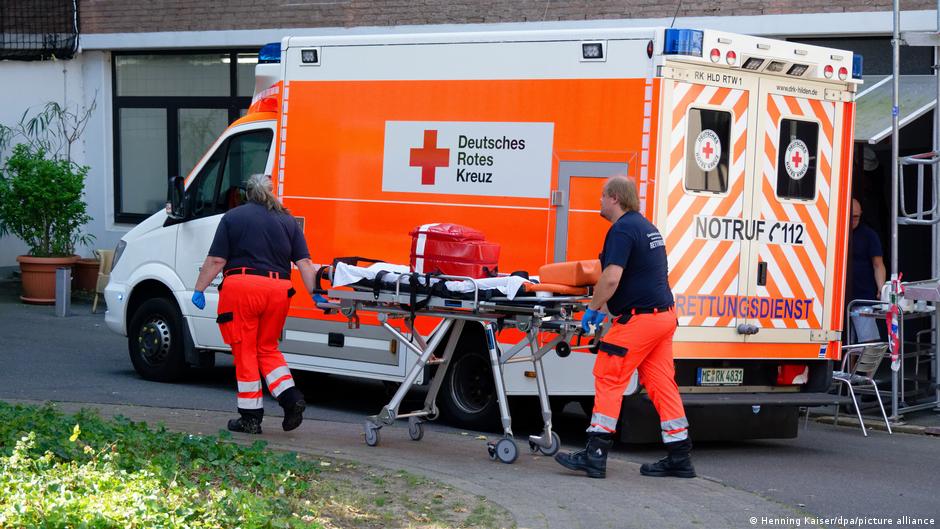
Emergency responders on the ground reported the strain of sustained heat waves. Jonas Sonnenstuhl, a paramedic in Teltow, Brandenburg, observed that "conditions like strokes and heart attacks become more frequent and can also become life-threatening more quickly" during extreme heat events.
The 5,100-plus estimated deaths mark only the second time since systematic heat-death counting began in the early 2000s that Germany has recorded such a severe toll from a single heat event, underscoring the escalating public health challenge posed by temperature extremes.
Why this matters: If you live in Germany or another European country experiencing increasingly hot summers, these statistics directly affect your health risks. Heat-related deaths are not limited to people with existing conditions—the data shows entire weeks where mortality spikes across the general population. Understanding how many people actually die from heat, rather than relying on official diagnoses, helps public health officials and hospitals prepare resources and warn vulnerable populations before the next heat wave arrives.
What Happens Next
Germany's health authorities will likely expand heat-warning systems and emergency preparedness protocols ahead of summer 2027. The RKI may refine its heat-death estimation methodology based on the 2026 data. European nations may adopt similar statistical approaches to quantify their own heat-mortality burdens, potentially influencing climate adaptation funding and public health policy across the EU.
Sources: DW and other international news outlets.
Disclaimer: This article was produced with AI assistance based on publicly available news sources. While we strive for accuracy, NewsOracle makes no warranty as to the completeness or accuracy of the information. Errors and omissions may occur. Readers should independently verify all information before acting on it. NewsOracle does not intend to defame any individual or organisation and accepts no liability for any loss or damage arising from reliance on this content. Content is for informational purposes only and does not constitute legal, financial, medical, or professional advice. All rights reserved. Unauthorised reproduction prohibited.
Politics Desk
The NewsOracle Politics Desk covers US politics, Congress, the White House, Supreme Court, global elections and international relations.
Latest coverage: Germany